


 (843) 343-4542
 gerry@mda-recon.com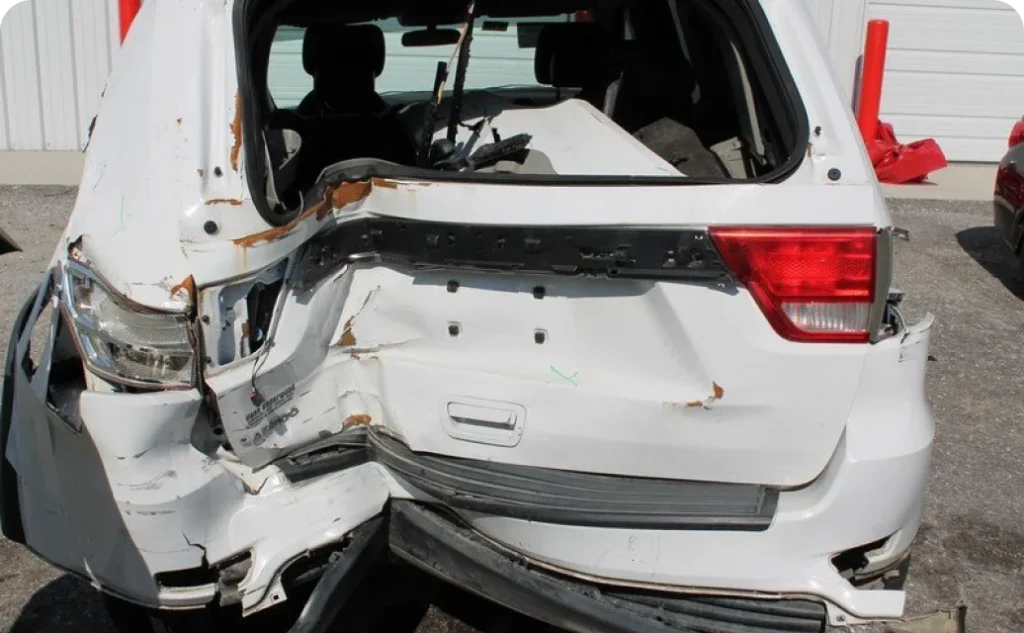
 Gerald C. McDevitt
Low Delta-V Collisions and Disputed Injury Claims: What the Physics Actually Show
Low-speed impacts produce less vehicle damage but can still generate significant occupant forces — forensic reconstruction can distinguish…
Forensic accident reconstruction uses physical evidence, vehicle data, and scientific analysis to determine exactly how a collision happened — and it can make or break a disputed liability case.
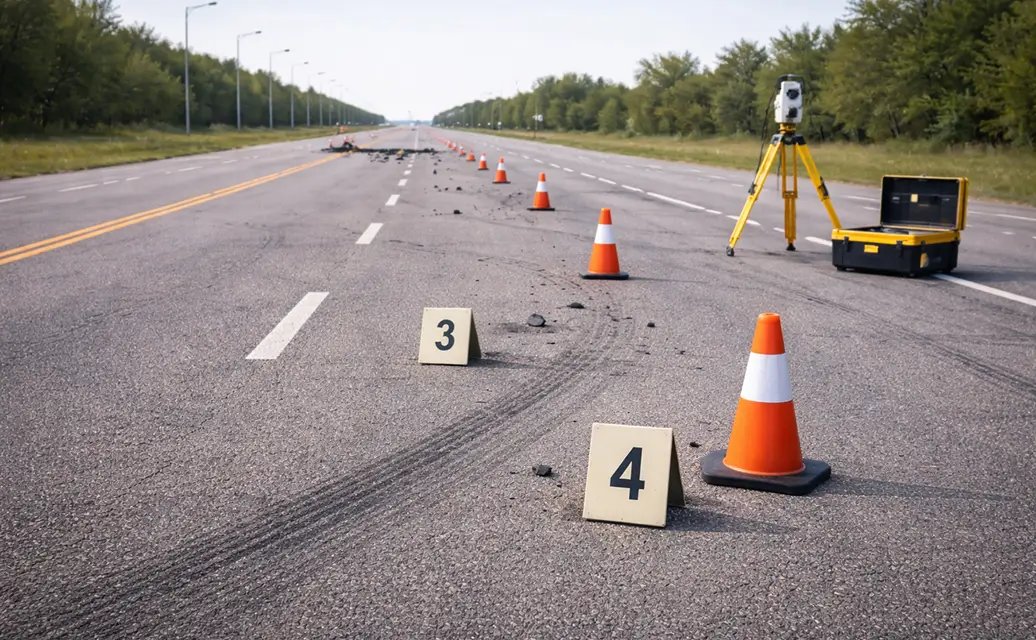
When a vehicle collision results in death or serious injury, the question of what happened — and more importantly, why — becomes the foundation of every legal claim and defense that follows. Witness accounts conflict. Police reports document what was observed at the scene but do not always explain the underlying cause. Insurance estimates address damage but not dynamics. And the physical evidence — tire marks, crush damage, debris patterns, vehicle rest positions — tells a story, but only if someone trained to read it is brought in to interpret it.
That is the role of a forensic accident reconstructionist: to apply the principles of physics, mathematics, and accepted scientific methods to the physical evidence of a collision and determine, as far as the evidence allows, how and why it occurred.
Accident reconstruction is the scientific process of investigating, analyzing, and drawing conclusions about the causes and events during a vehicle collision. It is a discipline grounded in the laws of physics — conservation of momentum, energy analysis, kinematics — applied to measurable physical evidence.
A qualified reconstructionist examines the evidence that the collision itself created: the length and direction of tire marks, the pattern and depth of vehicle crush damage, the location of debris and fluids on the roadway, the final rest positions of the involved vehicles, roadway geometry including grades, curves, and sight lines, and electronic data from the vehicle’s Event Data Recorder. Each piece of evidence constrains the range of possible scenarios. When analyzed together using established, published methods, they produce a reconstruction of the collision that can be expressed to a reasonable degree of scientific and accident reconstruction certainty.
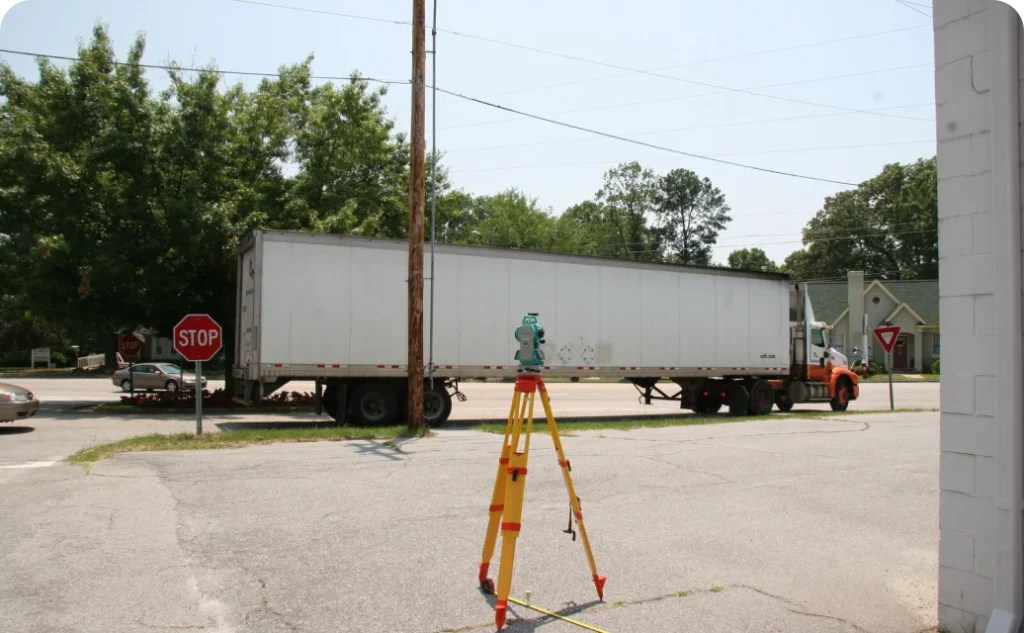
Modern accident reconstruction relies on measurement technology that produces documented, verifiable data. GNSS satellite positioning with RTK or PPK correction documents scene locations to centimeter-level accuracy when a fixed solution is held. RTK-equipped drones capture high-resolution aerial imagery of the collision scene, producing measurable orthomosaic maps and 3D surface models through photogrammetry processing. A reflectorless total station measures evidence locations, roadway features, and vehicle positions. For interior scenes and vehicle compartments, handheld 3D scanning technology creates detailed spatial models.
Event Data Recorders — the vehicle’s “black box” — record pre-crash data — including indicated speed, brake switch status, accelerator position, and seat belt buckle status, and in many vehicles steering input — in the seconds before an event that triggers a recording. GNSS-based vehicle dynamics testing records speed and position during test runs, from which acceleration and braking are derived, and the data can be synchronized with video footage — producing courtroom demonstratives that allow a judge or jury to see the data in motion. And when law enforcement or other investigators have documented a scene using terrestrial laser scanners, the resulting point cloud data can be imported, processed, and integrated into the reconstruction.
The result is a reconstruction backed by measurable data and documented methodology, with its uncertainty stated.
Not every collision case requires a reconstruction. A low-speed fender bender with clear liability and minor injuries typically does not. But there are categories of cases where reconstruction expertise is not just helpful — it is essential.
Fatal collisions. When someone dies in a vehicle collision, the stakes of the litigation — criminal and civil — demand a level of forensic rigor that goes beyond the police report. The reconstructionist provides independent scientific analysis of speed, timing, the sequence of events, and physical causation.
Disputed liability. When both sides claim the other was at fault, the physical evidence is often the most reliable guide. A reconstruction based on tire marks, crush damage, and electronic data can establish the sequence of events independently of witness testimony.
Speed disputes. When the central question is how fast a vehicle was traveling, a reconstructionist can calculate speed from multiple independent sources — tire mark analysis, crush energy calculations, EDR data — and cross-validate them against each other.
Pedestrian and bicycle collisions. These cases involve complex dynamics including pedestrian kinematics, throw distance analysis, driver perception-reaction time, visibility, and lighting conditions. The physics of a vehicle striking a pedestrian are fundamentally different from vehicle-to-vehicle impacts and require specialized analysis.
Commercial vehicle collisions. Collisions involving tractor-trailers, buses, and other commercial vehicles involve different weight dynamics and braking characteristics, and often electronic data from engine and brake modules, along with regulatory records the reconstruction has to account for.
Criminal charges. Vehicular homicide, felony DUI, and reckless driving cases carry the potential for imprisonment. Both prosecution and defense need forensic analysis with the methodology documented, so it can be tested under the court’s admissibility standards and on cross-examination.
Beyond the physics of the collision itself, a qualified reconstruction expert can analyze the human factors that are often at the center of negligence and liability questions: could the driver have seen the hazard and reacted in time to avoid the collision?
Applying published human factors research, a reconstruction expert evaluates the visibility and conspicuity of a hazard under the specific conditions that existed at the time — lighting, weather, roadway geometry, obstructions, and the position and movement of the threat relative to the driver’s line of sight. The expert then calculates the time and distance available for the driver to perceive the hazard, recognize it as a threat, decide on an evasive action, and execute that response. This perception-reaction time analysis is grounded in decades of published scientific research on how drivers detect and respond to hazards under varying conditions.
Using established human factors data, the expert can determine whether the available time and distance were sufficient for a given percentile of the driving population to perceive and react to the threat. For example, the expert might determine that a pedestrian became visible to the driver at 250 feet, that the vehicle was traveling at 45 miles per hour, and that the total available time from the point of possible detection to impact was 3.8 seconds. The expert can then compare that available time against published perception-reaction time values and opine on whether a reasonably attentive driver would have had sufficient time to detect the hazard and take effective evasive action.
This analysis translates the physical evidence — speeds, distances, sight lines — into a human context. It gives the trier of fact a measured basis for evaluating the time the driver had available to respond.
A qualified reconstruction expert can determine speeds, distances, timing, the physical sequence of events, and whether the conditions allowed a reasonably attentive driver to perceive and react to a hazard. What the expert cannot determine is the intent or conscious decision-making of a specific individual, nor what the driver subjectively perceived at the moment of the collision. Those are questions of fact for the trier of fact. The expert provides the scientific framework — the measurable reality of what was visible, what time was available, and what a given percentile of drivers could have done under those conditions — and the trier of fact applies that framework to the specific facts of the case.
Not all reconstruction experts are equal, and the quality of the expert affects the quality of the evidence in the case. The expert should have extensive experience in the specific type of collision at issue. They should use measurement methods suited to the evidence — GNSS positioning, drone mapping, EDR retrieval tools, total station measurement, 3D scanning, and forensic animation software — and state the uncertainty in their measurements. Their methodology should be documented, transparent, and based on scientifically accepted principles. They should have a record of courtroom testimony, with a methodology developed to meet Daubert and Frye admissibility standards. And their opinions should follow the evidence — not the interests of the side that hired them.
An expert who has been qualified and accepted in state, federal, and military courts, who has reconstructed or investigated hundreds of fatal and serious injury collisions, and who has been cross-examined by counsel on both sides brings the kind of record that lets the work be judged on its merits.
The process typically begins with a confidential initial consultation at no charge. The attorney provides available case materials — the police report, photographs, witness statements, and any vehicle inspection records — and the expert provides a preliminary assessment of the forensic questions at issue and the methodology required to address them. From there, the expert and attorney agree on a scope of work, and the expert proceeds with the analysis, scene inspection (if warranted), EDR extraction (if data is available), and preparation of an expert report.
The expert report documents the analysis, methodology, findings, and opinions, expressed to a reasonable degree of scientific and accident reconstruction certainty. The expert is then available for deposition and trial testimony as needed.
Accident reconstruction is not a luxury in serious collision cases. It is the scientific foundation on which the legal arguments are built. Whether you are prosecuting a vehicular homicide, defending a driver accused of negligence, or evaluating a claim involving catastrophic injuries, a qualified forensic reconstruction expert provides the objective, documented analysis that the case requires. The reconstructionist’s job is to read the physical evidence accurately and explain it clearly, whichever side it favors.
32+ years of experience. Hundreds of fatal and serious injury collisions reconstructed or investigated. Qualified and accepted as an expert in state, federal, and military courts.
Gerald C. McDevitt
Low-speed impacts produce less vehicle damage but can still generate significant occupant forces — forensic reconstruction can distinguish…
 Gerald C. McDevitt
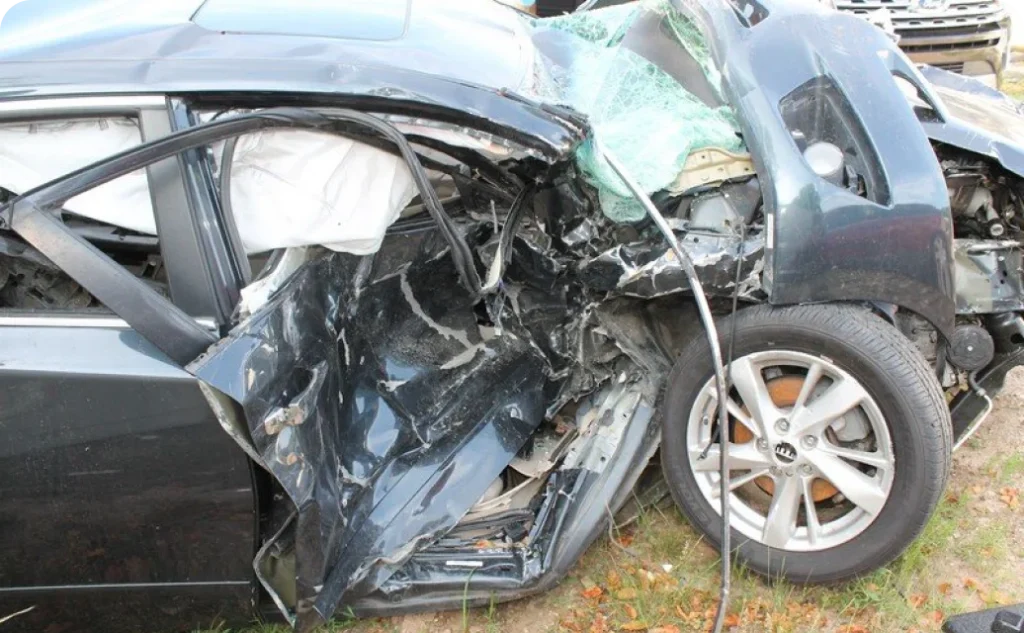
Proving that impairment caused a fatal collision — not just that the driver was impaired — requires a…
 Gerald C. McDevitt
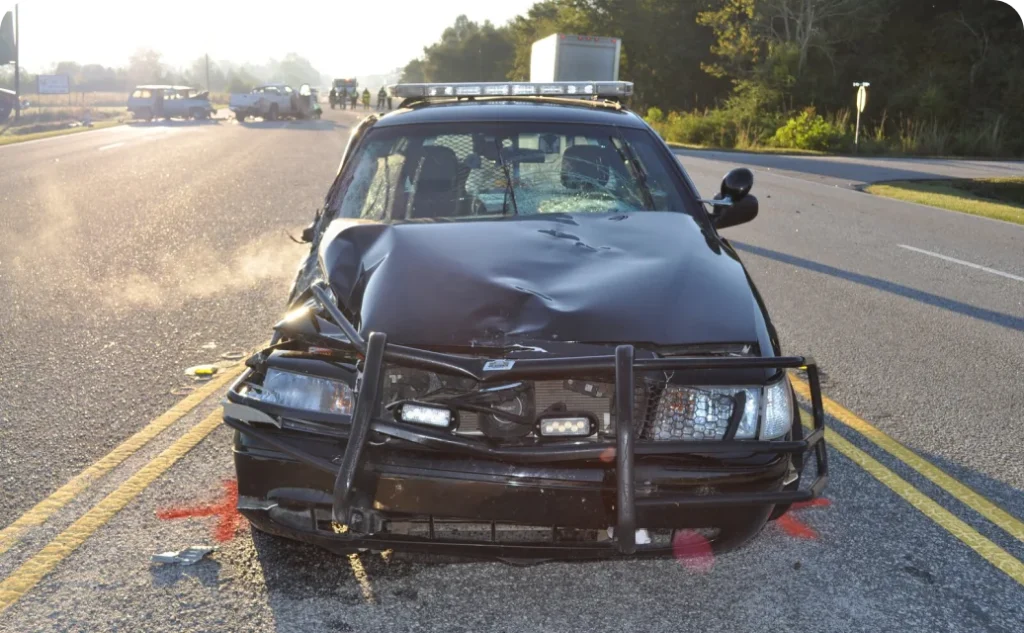
A vehicle cannot leave a scene without leaving evidence — paint transfer, glass, tire impressions, and debris patterns…
 Gerald C. McDevitt
Tractor-trailer and fleet vehicle collisions involve federal regulatory requirements, electronic logging devices, and complex vehicle dynamics that demand…