


 (843) 343-4542
 gerry@mda-recon.com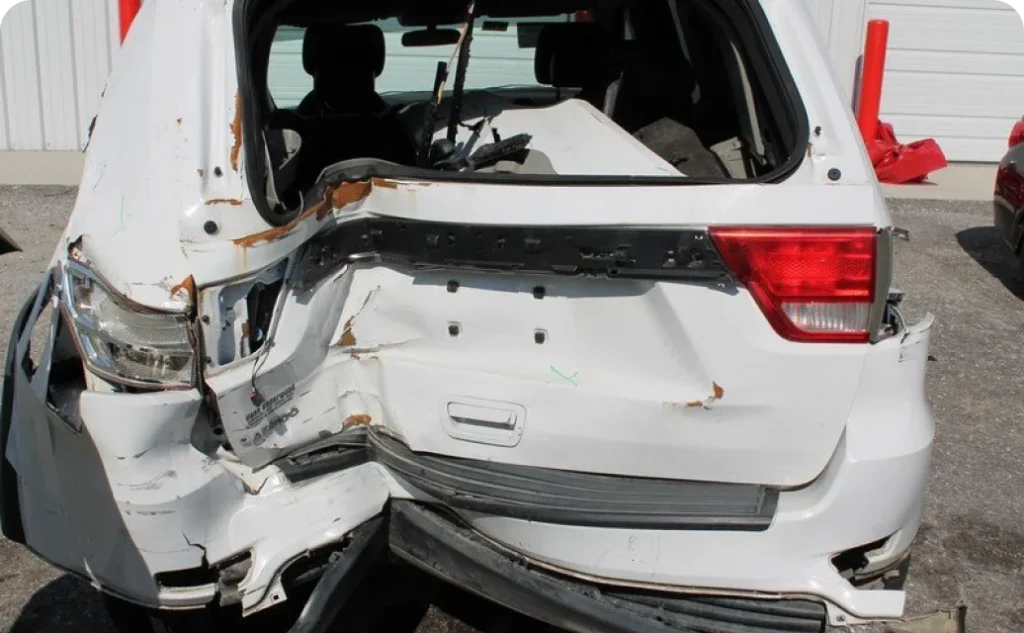
 Gerald C. McDevitt
Low Delta-V Collisions and Disputed Injury Claims: What the Physics Actually Show
Low-speed impacts produce less vehicle damage but can still generate significant occupant forces — forensic reconstruction can distinguish…
Tractor-trailer and fleet vehicle collisions involve federal regulatory requirements, electronic logging devices, and complex vehicle dynamics that demand a reconstructionist with specific heavy-vehicle expertise.
Commercial vehicle collisions operate in a regulatory, evidentiary, and financial environment that distinguishes them from most other categories of traffic case. The reconstruction analyst must work with federal regulations enforced by the Federal Motor Carrier Safety Administration, multiple independent digital data sources with different retention characteristics, vehicle dynamics that differ markedly from passenger car behavior, and mechanical systems — particularly air brakes — whose state of adjustment at the moment of collision can bear directly on causation. Add to this the reality that a fully loaded tractor-trailer may weigh eighty thousand pounds or more, roughly twenty times the mass of a typical passenger vehicle, and the complexity becomes clear.
Gerald McDevitt reconstructs commercial motor vehicle incidents across a range of case types — tractor-trailers, straight trucks, delivery vehicles, fleet sedans, and commercial passenger vehicles. The methodology addresses not only what happened in the seconds surrounding the collision, but the mechanical, digital, and operational context that shaped it.
The differences between commercial vehicle and passenger car dynamics extend far beyond mass. Heavy vehicles behave very differently in acceleration, deceleration, lateral motion, rotational motion, roll, pitch, and handling characteristics — and each of these has direct implications for reconstruction.
Articulation is a defining characteristic. A tractor-trailer is not a single rigid vehicle but two connected units that move in relationship to each other through a fifth-wheel coupling. This articulation produces loss-of-control modes that passenger vehicles do not have: jackknifing, in which the tractor’s drive wheels lose traction and the tractor rotates about the fifth-wheel coupling, folding toward the trailer; trailer swing-out, in which the trailer’s wheels lose traction and the trailer swings out of its path while the tractor holds its line; and dog-tracking, in which the trailer tracks offset from the tractor’s path due to alignment or mechanical issues. Each of these conditions produces distinctive patterns of roadway evidence that must be correctly interpreted.
High centers of gravity make commercial vehicles disproportionately susceptible to rollover, particularly when loaded with liquid cargo that can surge or high-profile freight. A maneuver that a passenger vehicle performs routinely — a sharp evasive swerve, a highway exit ramp at moderate speed — can initiate rollover in a fully loaded tractor-trailer. Rollover reconstruction considers the vehicle’s load distribution, center of gravity, and roll threshold to the extent the evidence documents them, together with the maneuver that triggered the loss of control.
Off-tracking — the tendency of trailer wheels to track inside the tractor’s path in low-speed turns, and in some high-speed maneuvers to track outside it — affects reconstruction of collisions in intersections, at driveways, and in tight maneuvers. A trailer can strike an object the tractor cleared, or a pedestrian or cyclist the driver may have believed was clear. Off-tracking analysis uses the specific tractor and trailer geometry and the best available evidence of the turning path and speed.
Acceleration and deceleration capability differ substantially. A loaded commercial vehicle accelerates slowly and, even with its brakes in proper adjustment, needs considerably more distance to stop from the same speed than a passenger vehicle. These basic facts shape the reconstruction of lane-change, merging, and following-distance collisions — and they make many of the assumptions that apply to passenger vehicles inappropriate for heavy trucks.
Heavy commercial vehicles — tractor-trailers and most larger straight trucks — use air brakes rather than hydraulic brakes, and the mechanical complexity of these systems is one of the most under-appreciated aspects of commercial vehicle reconstruction. Air brake systems include the air compressor, primary and secondary reservoirs, treadle valve controlled by the driver, spring brake chambers, service brake chambers, pushrods, slack adjusters, S-cams, brake drums and shoes, and the tractor protection and trailer supply valves that manage air flow between tractor and trailer.
One of the most important parameters in a post-collision commercial vehicle brake examination is pushrod stroke — the distance the brake chamber pushrod travels when the brakes are applied. Federal regulation (49 CFR 393.47) and the Commercial Vehicle Safety Alliance’s North American Standard Out-of-Service Criteria set pushrod stroke limits specific to the chamber size and whether the chamber is a standard or long-stroke design; the edition of the criteria in effect on the date of the inspection is the one that applies. When pushrod stroke exceeds the regulatory limit, the brakes are said to be out of adjustment. The consequence is reduced braking force at the affected wheel — in severe cases little or none — which increases the distance required to stop the vehicle.
The conditions of measurement matter. The Commercial Vehicle Safety Alliance’s North American Standard inspection procedure measures stroke with the air system at 90 to 100 pounds per square inch, the engine off, and a full service brake application held. After a crash, damage to the air system can make those conditions impossible to reproduce, so post-crash stroke measurements have to be read in light of the air pressure and brake application under which they were taken. Gerald McDevitt performs the post-collision vehicle inspections and brake measurements himself, and documents the air pressure and application conditions under which each measurement is taken.
For a reconstruction expert, pushrod stroke findings can bear directly on collision causation. A tractor-trailer with multiple out-of-adjustment brakes requires meaningfully more distance to stop than one with a properly adjusted system. When the reconstruction calculates the stopping distance required to avoid a collision and compares it against the actual brake system condition, the analysis can address whether the collision would have been avoidable with a brake system in proper adjustment.
Engine control module data from a commercial vehicle can provide one of the most detailed pre-crash records available in any category of case. Unlike passenger vehicle event data recorders, which capture a short window of parameters around a crash event, commercial ECM systems can log extended vehicle operational data: vehicle speed history, engine RPM, throttle position over time, service brake switch status, cruise control status, and hard-braking or deceleration-triggered events that occurred before the collision, as well as a last-stop record covering the period around the vehicle’s final stop. ECM speed is typically derived from the transmission output, so it is affected by wheel slip and the programmed tire size.
Commercial ECM extraction requires specialized knowledge of manufacturer-specific protocols. Heavy-truck engines come from Cummins, Detroit Diesel, PACCAR, Volvo and Mack, Navistar (International), and, in older trucks, Caterpillar, and each manufacturer uses its own proprietary download software, connector types, and data formats. That work calls for heavy-vehicle download training distinct from passenger vehicle Crash Data Retrieval, which is why heavy-truck module downloads are performed by James Sloan, a sub-contractor trained in those tools. Improper connection or the wrong software can alter or overwrite stored data, and overwritten data generally cannot be recovered.
ECM data must also be interpreted in context. Hard-brake events are triggered by deceleration thresholds, not by airbag deployment, and these events may have occurred minutes or hours before the collision in response to unrelated driving conditions. Distinguishing a pre-crash hard-brake event from an unrelated earlier event requires correlation with physical evidence, roadway conditions, and timing data.
Beyond the primary ECM, additional modules on a commercial vehicle store relevant data. Anti-lock brake system modules may log fault codes and wheel-speed behavior. Trailer ABS modules on equipped trailers may record faults. Transmission control modules store shift and performance data. Where available, these modules add to the engine ECM record.
The Federal Motor Carrier Safety Administration requires most interstate drivers who must keep hours-of-service records to use electronic logging devices. ELD systems record driver duty status, hours on duty, driving time, rest breaks, and off-duty periods with far greater reliability than the paper logbooks ELDs replaced. For reconstruction purposes, ELD data provides a record — automatic for driving time, and based on the driver’s own entries for other duty status — of how long the driver had been working, when rest breaks were taken, and how the driver’s duty-status timeline relates to the time of the collision.
Driver fatigue is a frequent theory in commercial vehicle cases. ELD data fixes the driver’s duty timeline — how far into a duty period, at what time of day, after how much rest — and that timeline can be set alongside the physical pre-crash timeline, giving whichever qualified expert addresses fatigue a documented foundation to work from.
When ELD data works in combination with ECM data, the analysis becomes substantially more powerful. ECM tells what the truck was doing in the seconds and minutes before impact. ELD tells how long the driver had been doing it. Together, these sources can support or undercut causation theories that rest on driver performance, such as inattention or a delayed response to a developing hazard.
Beyond the regulatory ELD, most modern commercial fleets operate third-party telematics platforms — Samsara, Geotab, Omnitracs, Lytx, Motive (formerly KeepTruckin), Netradyne, and others. These systems use a telematics control unit installed in the vehicle that continuously transmits engine data, GPS position, and increasingly, video imagery from forward-facing and driver-facing cameras back to cloud-based servers operated by the telematics provider or retained by the carrier.
Telematics data has become one of the most consequential evidence categories in commercial vehicle litigation. A single telematics platform may record continuous GPS position and speed at one-second intervals, cumulative driving behavior scoring, hard-brake and hard-acceleration events with video clips attached, forward-facing video of the roadway before and during the collision, driver-facing video showing driver attention, phone use, seatbelt status, and signs of fatigue, lane-departure and following-distance warnings issued to the driver, and engine parameters read from the vehicle data bus, alongside GPS and accelerometer data that are independent of the ECM.
The implications for reconstruction are substantial. Video footage from the moments before a collision can establish the roadway environment, traffic conditions, pedestrian or cyclist position, signal states, and driver attention with a directness other sources rarely provide. Paired with telemetry showing vehicle speed, brake application, and lane position, a telematics record can document much of the pre-impact sequence in detail, within the limits of the platform’s sampling rate, GPS accuracy, and video frame rate.
Telematics evidence requires early preservation. Cloud-based retention varies by provider and by the carrier’s service tier. Raw video is typically retained for a limited period before being purged or overwritten. Event-triggered clips may be retained longer than continuous footage. Identifying the provider, the retention categories, and the relevant time windows early makes that data easier to locate before it is gone. Gerald McDevitt works with retaining counsel to identify the telematics platforms in use on the subject vehicle and the specific data categories that should be preserved before scheduled purge.
Modern commercial vehicles increasingly carry collision warning systems, lane-departure warning, adaptive cruise control, and automatic emergency braking systems derived from or analogous to passenger vehicle advanced driver assistance systems. Where the data exist, the reconstruction can address whether these systems activated during the pre-crash sequence and how the driver responded to any warnings issued.
Collision warning activations, lane-departure alerts, following-distance violations, and adaptive cruise interventions may be logged by the vehicle’s systems, by the carrier’s telematics platform, or both. These data points support analysis of driver attention and response in the moments leading to the collision. A documented collision warning that preceded impact by several seconds — without corresponding driver brake or steering response — supports a different causation analysis than a collision that occurred without system activation.
The difference in mass between a loaded tractor-trailer and a passenger vehicle produces what is sometimes called disproportionate damage: damage patterns that can look mismatched. The two vehicles experience equal and opposite contact forces, but the much lighter passenger vehicle undergoes a far larger change in velocity, and differences in structural stiffness and ride height typically concentrate the deformation in the passenger vehicle. A heavy commercial vehicle involved in a serious passenger-vehicle collision may emerge with damage that looks modest — a cracked bumper, scraped paint, a bent step — while the passenger vehicle is catastrophically deformed. Interpretation of commercial vehicle collision damage requires familiarity with this asymmetry.
Scene evidence in commercial cases is typically more extensive than in passenger vehicle collisions because of the mass and energy involved. Tire marks from multiple axles — steering axle, drive axles, trailer axles — require careful differentiation, and trucks and trailers with anti-lock brakes often leave faint or intermittent marks rather than classic skids. Fluid trails, gouge marks, roadway scarring, and damaged infrastructure all contribute to the reconstruction. Trailer underride, load shift, and cargo spillage present additional evidence categories unique to commercial cases.
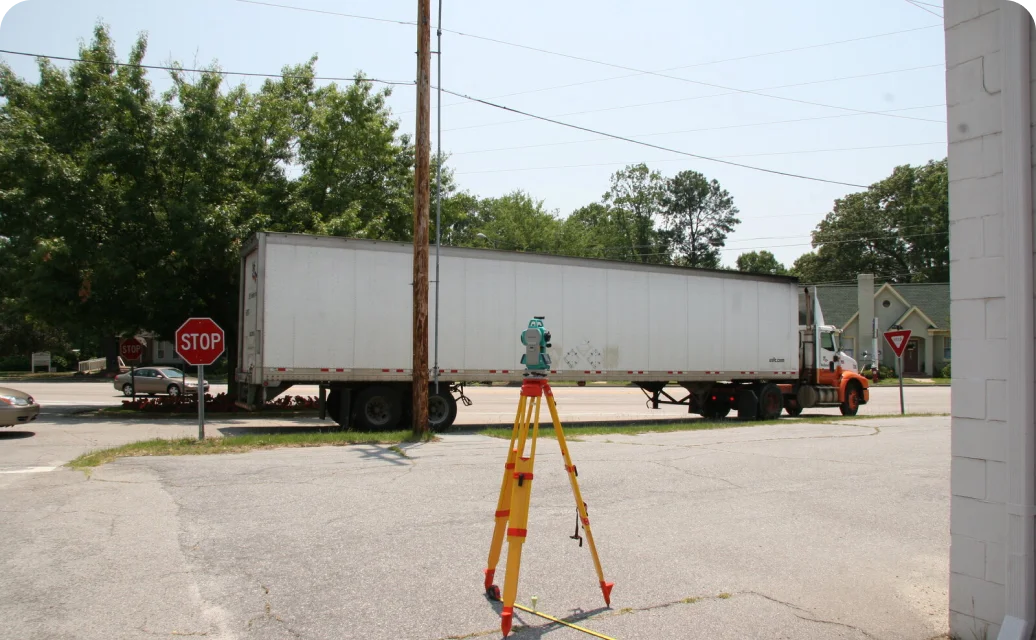
Gerald McDevitt documents commercial vehicle scenes using Emlid Reach RS3 GNSS, a Sokkia reflectorless total station, Autel EVO II Pro RTK V3 drone aerial photogrammetry for the large footprints typical of commercial collisions, Recon3D handheld LiDAR scanning for detailed vehicle and trailer documentation, Bosch Crash Data Retrieval for passenger-vehicle event data, and Racelogic VBOX GNSS data logger for speed and motion data when testing supports the analysis. Commercial vehicle ECM and event data extraction is performed by James Sloan, engaged by McDevitt and Associates, Inc. as a qualified sub-contractor, and integrated into the overall reconstruction analysis.
Federal Motor Carrier Safety Administration regulations are not merely administrative requirements. Pre-trip inspection records, maintenance logs, and hours of service records can all contribute to the picture of how the collision came to happen.
Where a documented mechanical condition — out-of-adjustment brakes, worn tires, inoperative lights — is at issue, the reconstruction addresses whether it physically contributed to the collision. Whether a regulation was violated is a question for counsel and qualified regulatory experts. Each connection requires careful analysis to distinguish actual causal contribution from coincidental regulatory failure.
The preservation window for commercial vehicle evidence is often shorter than for passenger vehicle evidence. Trucks are released from the scene quickly. ECM data can be overwritten as the vehicle continues to operate. Telematics video is subject to automated retention limits that frequently run in days or weeks rather than months. Carriers must retain ELD records for six months under federal rules, but other carrier data may be purged on routine schedules. Maintenance records, pre-trip inspection documentation, and driver logs are subject to carrier record-keeping practices.
Whether and when to send a preservation letter is counsel’s decision. From the forensic side, the items most worth preserving early include the vehicle in its post-collision condition (including brake adjustment as found), ECM data, telematics data from all platforms in use on the vehicle (with particular attention to video), ELD records, driver qualification files, pre-trip and post-trip inspection records, maintenance and repair records for the subject tractor and trailer, hours of service records, and dispatch and load documentation for the trip during which the collision occurred. Gerald McDevitt can assist retaining counsel with the specific categories of evidence to preserve and the technical requirements for proper preservation of digital records.
Depending on the evidence available, a commercial vehicle reconstruction can address vehicle speeds, the sequence of pre-crash events, brake application and timing, the mechanical condition of the vehicle as it relates to collision causation, and the time and distance available to perceive and respond to the hazard.
A reconstruction expert cannot determine the intent or conscious decision-making of the driver or any carrier personnel, nor what any individual subjectively perceived at any given moment. The expert provides the physical, mechanical, and digital framework; the finder of fact applies that framework to the specific people in the case.
Commercial vehicle and fleet cases are among the most demanding in accident reconstruction. The unique dynamics of articulated heavy vehicles, the complexity of air brake systems and their adjustment-dependent performance, the richness of digital evidence across ECM, ELD, and third-party telematics platforms, and the interplay between physical causation and regulatory compliance together require analytical depth that goes well beyond standard traffic collision work. For plaintiff and defense counsel alike, a qualified reconstruction expert with commercial vehicle experience turns disputed questions into documented analysis of what the physical, mechanical, and digital evidence actually shows.
1970 Armory Drive, Mount Pleasant, SC 29466
Gerald C. McDevitt
Low-speed impacts produce less vehicle damage but can still generate significant occupant forces — forensic reconstruction can distinguish…
 Gerald C. McDevitt
Proving that impairment caused a fatal collision — not just that the driver was impaired — requires a…
 Gerald C. McDevitt
A vehicle cannot leave a scene without leaving evidence — paint transfer, glass, tire impressions, and debris patterns…
 Gerald C. McDevitt
When a pedestrian or bicyclist is struck by a vehicle, the body's trajectory, throw distance, and impact kinematics…