


 (843) 343-4542
 gerry@mda-recon.com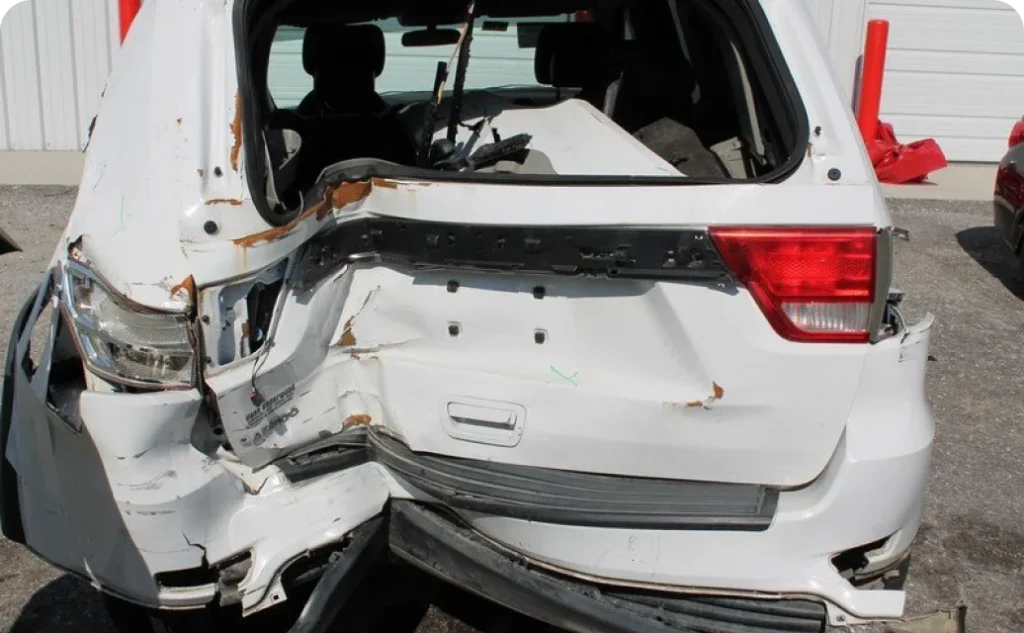
 Gerald C. McDevitt
Low Delta-V Collisions and Disputed Injury Claims: What the Physics Actually Show
Low-speed impacts produce less vehicle damage but can still generate significant occupant forces — forensic reconstruction can distinguish…
Most modern vehicles record speed, braking, throttle input, and seatbelt status in the seconds before a crash — here is what that data can prove in court and why timing matters.
If you are an attorney or insurance adjuster handling a vehicle collision case where speed, braking, or driver behavior is disputed, there may be evidence sitting inside the vehicle itself — and it may not be there for long.
The Event Data Recorder, commonly called the vehicle’s “black box,” is a function built into most modern passenger vehicles that records data in the seconds surrounding a crash event. When the data is properly retrieved and interpreted alongside the physical evidence, it can corroborate or contradict witness testimony, test police estimates, and add a recorded layer of evidence to what the physical evidence shows about the moments that matter most.
An Event Data Recorder is usually a function of the vehicle’s airbag control module (ACM), and in some vehicles of another control module. It is not a standalone device installed after the fact — it is built into the vehicle at the factory. The federal rule, 49 CFR Part 563, does not require a vehicle to have an EDR. For light vehicles built on or after September 1, 2012 that have one, it standardizes what the EDR must record and requires that the data be retrievable with a commercially available tool. Many vehicles built before that date also have EDRs, and what they record varies by manufacturer.
The EDR monitors vehicle systems during normal operation. When it detects an event that crosses its trigger threshold — a change in velocity within a short interval, or the deployment of an airbag or other restraint — it records a snapshot of vehicle data from the seconds before and during the event. The data is stored in non-volatile memory, so it is designed to survive the loss of power in a crash, and a properly performed download reads it without erasing it. Whether the record is protected from being overwritten depends on the kind of event, as explained below.
The specific data recorded varies by manufacturer, model, and model year. For vehicles subject to Part 563, the required data includes indicated vehicle speed, accelerator pedal (or throttle) position, and service brake status (on or off) for the seconds before the event; the driver’s seat belt buckle status; frontal airbag deployment timing; and the longitudinal change in velocity, or delta-V, during the event. Many vehicles also record optional elements such as engine RPM, steering input, front passenger belt status, lateral delta-V, and ABS and stability control activity.
Some newer vehicles equipped with advanced driver assistance systems may also record, depending on the manufacturer, forward collision warning activation, automatic emergency braking engagement, lane departure events, and adaptive cruise control status. As vehicle technology evolves, the data captured by EDRs continues to expand.
Each data point is timed relative to time zero — a reference point set by the module’s crash algorithm — at a fixed interval: a few samples per second for the pre-crash data, and 100 samples per second for the change in velocity during the crash itself. The data is recorded by the vehicle’s own electronic systems at the time of the event, not reconstructed afterward. It is still sensor data, and it has to be interpreted — which is why its limits matter.
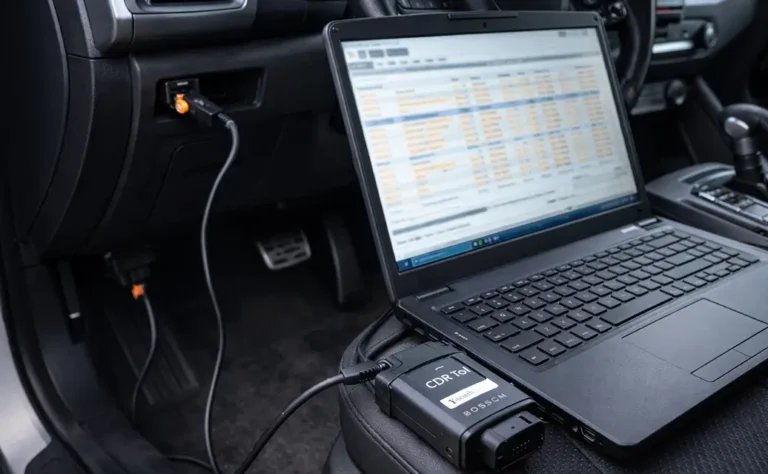
The industry-standard retrieval tool in the United States is the Bosch Crash Data Retrieval (CDR) system; some makes and models require a manufacturer-specific tool, so coverage is confirmed for the actual vehicle first. The tool connects through the vehicle’s diagnostic port or, when that is not possible — for example, when the vehicle has lost power or is heavily damaged — directly to the module, which may need to be removed from the vehicle.
The download itself can be quick, and the software produces a standardized report of the recorded data; confirming coverage, documenting the vehicle and module, and analyzing the data take longer. The retrieval should be done by someone trained in the tool and the procedure, because improper handling of the module or incorrect connection procedures can compromise the data, and the chain of custody should be documented through retrieval and analysis.
Who may retrieve the data is also a question of ownership. Under the federal Driver Privacy Act of 2015, the data belongs to the vehicle’s owner or lessee, and anyone else generally needs the owner’s or lessee’s consent, or authorization from a court or other judicial or administrative authority, to retrieve it. A number of states have their own EDR statutes as well.
In litigation, EDR data is used in several ways.
Speed determination. When the central question is how fast a vehicle was traveling before the collision, EDR data provides a recorded speed that can be checked against the physical evidence. It gives a recorded reference point that witness estimates can be tested against, and it is especially valuable where no tire marks were left to calculate speed from.
Driver behavior analysis. Did the driver brake before the collision? If so, when? Was the driver accelerating? Was the seat belt buckled? These questions, which often form the core of liability and negligence arguments, are informed directly by the recorded brake, accelerator, and belt data — read within the limits described below.
Crash severity quantification. Delta-V — the change in velocity during the impact — is a widely used measure of crash severity. It is relevant where the relationship between the crash forces and the claimed injuries is disputed, although whether a particular injury resulted is a medical and biomechanical question that the EDR does not answer.
Validation or contradiction of other evidence. EDR data can be compared against witness testimony, police estimates, and other forensic calculations to test their accuracy. When an EDR shows the vehicle was traveling 45 mph and a witness claims it was going 80, the recorded data, checked against the physical evidence, gives an objective basis for testing the estimate.
An event data recorder is a contemporaneous record made by the vehicle itself, and that is why it carries weight. It is also a record with known limits, and those limits belong in the report next to the numbers.
The pre-crash data is a short buffer, not a continuous trace. In the vehicles most often encountered it covers at least the five seconds before time zero, at two samples per second; older modules that predate the rule vary. A recent federal rule change lengthens that buffer considerably for vehicles built in future model years, but it does not reach the vehicles in most cases now. And time zero is not the moment of first contact — it is the point at which the module’s algorithm woke or first detected a small change in velocity. In an oblique, offset, or underride impact those two moments can be meaningfully apart.
Recorded speed is normally derived from wheel or powertrain sensors rather than measured against the ground, so tire size, wheel lockup, drive-wheel spin, and ABS intervention can all move it away from true ground speed. The other pre-crash elements are coarser than they look: brake status is a switch state, not pedal force, and belt status is a buckle switch, not proof of proper use. The recorded change in velocity is captured over a window that closes when the module judges the event finished, so in a long or multiple-impact sequence the recorded value may not represent the whole collision — and in many vehicles only the longitudinal component is recorded at all. The federal specification itself allows ten percent on that figure.
In vehicles subject to the rule, a record written when a frontal airbag deploys — or a side or curtain airbag, in vehicles that record lateral delta-V — is locked against overwriting. Other records, including those from events where nothing deployed, may not be: in many modules they can be overwritten by a later event or aged out by ignition cycles, which is why the data should be retrieved as early as possible. And no single retrieval tool covers every make, model, and year.
The limit with the most consequence is the one that is easiest to miss. The module records an event only when the change in velocity crosses its trigger threshold or a restraint deploys. A contact below that threshold produces no record at all — so the absence of an event data recorder record is not evidence that no impact occurred.
None of this makes the data less useful. It is what makes it usable: it defines the conditions under which the record can be relied on, and what has to be established some other way.
EDR data is only useful if it still exists when it is needed, and delay is a frequent cause of its loss. If the vehicle is repaired, the airbag control module may be replaced and the original module discarded. If the vehicle is declared a total loss and sent to salvage, the module may be removed or the vehicle crushed. If the vehicle is returned to the owner and sold or traded, the data leaves with it.
In practice, when a case involves any question of speed, braking, or driver behavior, it pays to learn early where the involved vehicles are and whether their EDR data has been preserved. If a vehicle is still accessible, it should be secured and the data retrieved promptly, under whatever consent or protocol counsel arranges. If it has already been repaired, salvaged, or sold, the data may be gone for good.
Whether and when to send a preservation letter covering the vehicle and its electronic data is counsel’s decision. From the forensic side, the earlier a vehicle is secured, the more remains available to examine.
Event Data Recorder evidence, when it exists, is some of the most useful evidence available in vehicle collision litigation. Retrieved properly and read within its limits, alongside the physical evidence, it can answer questions that would otherwise rest on memory and estimate. But it is also perishable, and the window to retrieve it can close without warning. If your case involves a disputed collision, the vehicles and their data are worth locating early.
32+ years of experience. Hundreds of fatal and serious injury collisions reconstructed or investigated. Qualified and accepted as an expert in state, federal, and military courts.
Gerald C. McDevitt
Low-speed impacts produce less vehicle damage but can still generate significant occupant forces — forensic reconstruction can distinguish…
 Gerald C. McDevitt
Proving that impairment caused a fatal collision — not just that the driver was impaired — requires a…
 Gerald C. McDevitt
A vehicle cannot leave a scene without leaving evidence — paint transfer, glass, tire impressions, and debris patterns…
 Gerald C. McDevitt
Tractor-trailer and fleet vehicle collisions involve federal regulatory requirements, electronic logging devices, and complex vehicle dynamics that demand…