


 (843) 343-4542
 gerry@mda-recon.com
 Gerald C. McDevitt
Low Delta-V Collisions and Disputed Injury Claims: What the Physics Actually Show
Low-speed impacts produce less vehicle damage but can still generate significant occupant forces — forensic reconstruction can distinguish…
A vehicle cannot leave a scene without leaving evidence — paint transfer, glass, tire impressions, and debris patterns can identify the responsible vehicle and reconstruct the collision even without a witness.
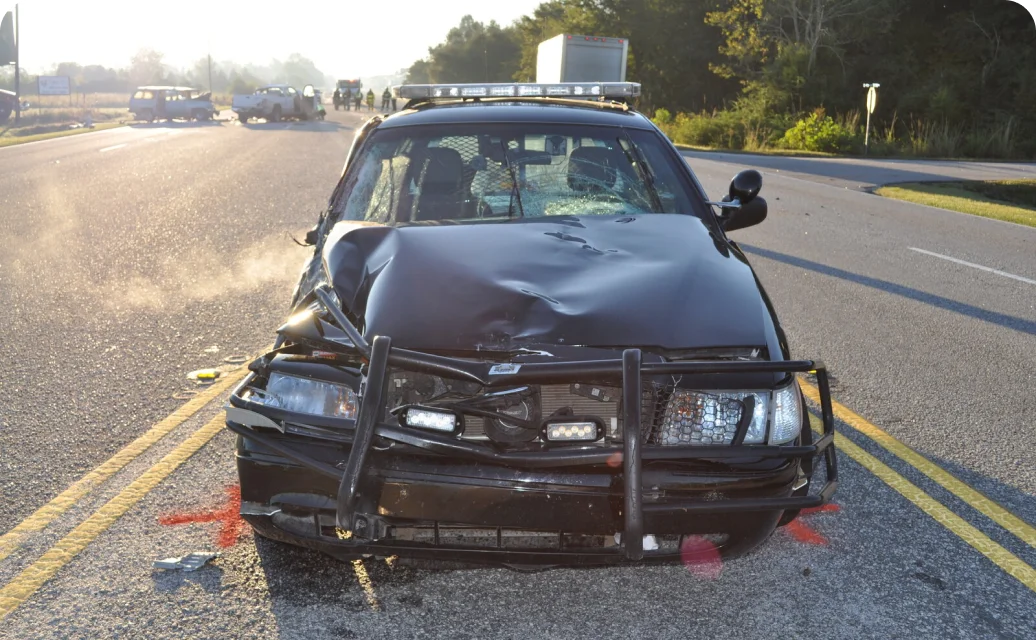
Hit-and-run cases are among the most challenging in forensic reconstruction. The responsible driver has fled the scene. The vehicle may not be identified for days, weeks, or months — if at all. Physical evidence at the scene is often limited to debris, paint fragments, roadway marks, and the damaged victim vehicle or pedestrian. And when a suspect vehicle is eventually located, the question of whether it actually caused the collision — and whether a specific person was driving at the moment of impact — often turns on evidence that requires careful forensic interpretation.
Gerald McDevitt has worked hit-and-run cases on both sides of the criminal and civil docket. The reconstruction methodology applies rigorous scientific principles to physical evidence — laboratory paint and material findings, broken components, impact patterns, glass and plastic debris, and the specific damage signatures that connect a suspect vehicle to the collision. Where the physical evidence supports identification, the analysis can be compelling. Where it does not, the expert’s responsibility is to say so.
The reconstruction of a hit-and-run collision differs from a standard collision reconstruction in three important ways. First, the responsible vehicle is typically absent from initial scene documentation, meaning the evidence from that vehicle must be reconstructed after the fact — often from fragments left at the scene. Second, the legal stakes are substantially higher. Hit-and-run involving death or serious injury is a felony in South Carolina (S.C. Code § 56-5-1210) and in most other states, and the evidence linking a specific vehicle and driver to the collision will be tested against the burden of proof in a criminal or civil case. Third, witness memory and subjective identification play a larger role, which makes independent physical evidence correspondingly more valuable.
The core questions in a hit-and-run reconstruction are typically: What vehicle caused this collision? Does the physical evidence link a specific suspect vehicle to this scene? If a suspect vehicle is identified, does the damage pattern match the collision dynamics? And, where applicable, what does the physical evidence show about occupant position and restraint use in the suspect vehicle?
Scene evidence in a hit-and-run case is often the most important evidence in the reconstruction, because it is often the earliest physical evidence of the responsible vehicle. Paint left at the scene — on the victim vehicle, on roadway infrastructure, on a pedestrian, or on a bicyclist — can be significant. Paint chips that keep their factory layer structure can, through laboratory analysis and the PDQ paint database, narrow the striking vehicle to a manufacturer and range of model years; smears usually narrow it less. Glass fragments, plastic trim pieces, badging, lens material, and mirror components all carry manufacturer-specific characteristics that can narrow the suspect vehicle pool.
Broken components recovered at the scene often bear part numbers, casting marks, or proprietary identifiers traceable to specific manufacturers or model runs. A headlight bezel, a turn signal lens, a grille emblem, or a section of trim can identify the make and model, and sometimes a range of model years, when the fragment is large enough or distinctive enough. Tire-mark patterns and scrape evidence on the roadway or on a struck pedestrian or cyclist can also contribute to vehicle identification when the marks carry tread signatures or damage signatures specific to the striking vehicle. In pedestrian cases, the location and height of documented injuries — lower-leg fractures at bumper height, for example — can be compared with the front-end geometry of a suspect vehicle and help indicate the type of vehicle involved.
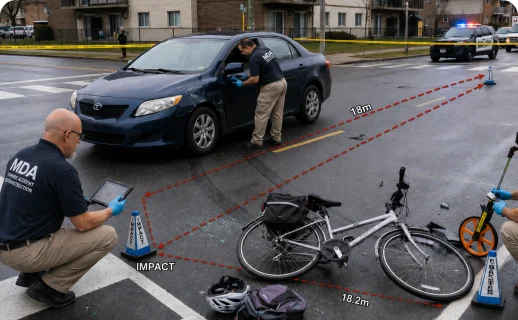
Scene evidence is perishable. Roadway conditions change within hours. Debris is cleared, often without detailed inventory. Weather removes paint transfer from pavement. Early and thorough documentation of the scene — photographic, photogrammetric, and three-dimensional — preserves evidence that would otherwise be lost. Gerald McDevitt integrates Emlid Reach RS3 GNSS mapping, a Sokkia reflectorless total station, Autel EVO II Pro RTK V3 drone aerial photogrammetry, and Recon3D handheld LiDAR scanning to produce comprehensive scene documentation in cases where the responsible vehicle must be reconstructed from its traces.
When a suspect vehicle is identified and located, the central forensic question is whether the vehicle’s damage and physical characteristics are consistent with the collision the scene evidence documents. This analysis proceeds on multiple axes.
Damage pattern matching evaluates whether the damage on the suspect vehicle is consistent with the collision dynamics reconstructed from the scene. Height of damage, direction of force, crush pattern, and component deformation on the suspect vehicle should align with the impact configuration indicated by the victim vehicle or pedestrian evidence. A suspect vehicle with damage at the wrong height, or damage inconsistent with the collision direction, may not be the vehicle that caused the collision regardless of other circumstantial factors.
Paint and material transfer analysis compares the suspect vehicle’s paint, plastic, and component materials against samples recovered from the scene. This analysis is typically performed by a forensic laboratory using microscopy, infrared spectroscopy, and chemical analysis, but the reconstruction expert integrates the laboratory findings into the overall physical picture. A paint match shows that the suspect vehicle could have been the source; combined with damage pattern matching, the association becomes substantially stronger.
Component recovery can provide one of the strongest links. When a broken component recovered at the scene physically fits a missing or damaged part of the suspect vehicle — a headlight housing, a mirror assembly, a section of trim — a physical fit, confirmed by the laboratory, can be strong evidence of association.
Identifying the specific person driving a suspect vehicle at the moment of impact is a distinct analytical question and one that requires particular care. In many hit-and-run cases, the identity of the vehicle’s owner is established long before the identity of the driver. A vehicle can be identified through license plate records, distinctive damage, or physical evidence at the scene, but the person behind the wheel may be contested — particularly in households or workplaces where multiple people have access to the vehicle.
Driver identification analysis in collision reconstruction examines the physical evidence of occupant position and movement during the collision. Seat belt loading marks, contact points within the vehicle interior, airbag contact, seat position, and the occupants’ injury patterns all contribute to the analysis. Event data recorder information, where available, can show the driver’s belt buckle status, and in some vehicles the driver seat track position, which can support or contradict accounts of who was driving.
The reconstruction expert’s role in driver identification is to establish what the physical evidence shows — not to identify any specific individual. The physical evidence may show, for example, that the driver was belted, where the seat was positioned, and what contact and loading marks are present in the driver’s position. Those findings can be compared with the documented injuries of the people involved, drawing on the published injury-mechanism literature, with medical or biomechanical experts consulted where a case calls for them. Who was driving remains a question for the trier of fact.
When a suspect vehicle is recovered in a hit-and-run case, event data recorder extraction becomes particularly valuable. If the collision triggered a recorded event, the EDR data can show whether that event is consistent with the reconstruction, along with pre-impact speed, accelerator and brake status, belt buckle status, airbag deployment, and the change in velocity. Many pedestrian and minor-contact impacts never reach the module’s recording threshold, so the absence of a record does not show that the vehicle was not involved.
The data should be retrieved as soon as possible after the suspect vehicle is located. Records from events where no airbag deployed can be overwritten as the vehicle continues to be driven, and the data is lost if the airbag module is replaced during repair. Gerald McDevitt retrieves and interprets EDR records with the Bosch Crash Data Retrieval tool, kept on current software.
An EDR record is not usually tied to a calendar date and time; it is linked to the vehicle’s ignition-cycle count, so when the event occurred has to be established from other evidence. A suspect vehicle whose EDR shows an event with speed and direction of force consistent with the reconstruction, at an ignition cycle consistent with the timeline, adds significant weight to the physical association — and an EDR record inconsistent with the reconstruction is just as significant.
Event data recorder data has limits that belong in the report next to the numbers. 49 CFR Part 563 does not require a vehicle to carry a recorder — it specifies what one must capture if the manufacturer fits it. The pre-crash buffer is short and sampled at intervals, not continuous, and it is timed from time zero — the point at which the module’s algorithm woke or first detected a small change in velocity — rather than from first contact. Recorded speed generally comes from wheel or powertrain sensors, so tire size, lockup, wheel spin, and ABS intervention can move it off true ground speed. The recorded change in velocity is captured over a window that can close before a long or multiple impact is over, in many vehicles only the longitudinal component is recorded, and the federal specification allows ten percent on it. Records from events where nothing deployed can be overwritten, and no single retrieval tool covers every vehicle. None of that makes the data less useful — it defines what the record can support, and what has to be established another way.
Modern hit-and-run investigations increasingly rely on video evidence from traffic cameras, commercial security systems, residential doorbell cameras, and dash-mounted recorders in nearby vehicles. While video analysis is a separate discipline, the reconstruction expert often works alongside video-forensic specialists to integrate video evidence into the overall reconstruction.
Video can confirm vehicle make, model, and color; document approximate speed; establish direction of travel before and after the collision; and in some cases capture license plate information or distinguishing features. When video evidence is available, the reconstruction expert, working with the video analyst, can test the video against scene measurements and physical evidence to test whether the video-depicted vehicle is consistent with the vehicle indicated by the scene evidence.
Early canvassing for video evidence matters. Many commercial and residential video systems overwrite recordings on rolling schedules of days or weeks, so nearby businesses, property owners, and traffic-camera operators are best contacted as soon as possible after the collision.
A hit-and-run reconstruction can help establish the physical characteristics of the striking vehicle from scene evidence, whether a suspect vehicle’s damage and physical properties are consistent with the collision, whether EDR data from a suspect vehicle is consistent with the reconstructed collision, and the physical evidence of occupant position and movement relevant to driver identification.
A reconstruction expert cannot identify a specific individual as the driver based solely on physical evidence, nor determine the intent or conscious decision-making of any party. Identification of a specific person remains a question of fact. The expert’s role is to establish the physical framework against which the trier of fact evaluates the competing accounts and identification evidence in the case.
Hit-and-run cases demand forensic rigor. The evidence is often fragmentary, the stakes are high, and the links between scene evidence, suspect vehicle, and suspect driver have to be examined with scientific care. For prosecutors, for defense counsel concerned about mistaken identification, and for civil counsel on either side, a qualified reconstruction expert provides a physical evidence framework for the case — and the honest limits of what that evidence can and cannot show.
1970 Armory Drive, Mount Pleasant, SC 29466
Gerald C. McDevitt
Low-speed impacts produce less vehicle damage but can still generate significant occupant forces — forensic reconstruction can distinguish…
 Gerald C. McDevitt
Proving that impairment caused a fatal collision — not just that the driver was impaired — requires a…
 Gerald C. McDevitt
Tractor-trailer and fleet vehicle collisions involve federal regulatory requirements, electronic logging devices, and complex vehicle dynamics that demand…
 Gerald C. McDevitt
When a pedestrian or bicyclist is struck by a vehicle, the body's trajectory, throw distance, and impact kinematics…