


 (843) 343-4542
 gerry@mda-recon.com
 Gerald C. McDevitt
Low Delta-V Collisions and Disputed Injury Claims: What the Physics Actually Show
Low-speed impacts produce less vehicle damage but can still generate significant occupant forces — forensic reconstruction can distinguish…
EDR data is often the most decisive evidence in a UCMJ vehicular manslaughter case — but it can be permanently lost if the vehicle is released, repaired, or destroyed before extraction.
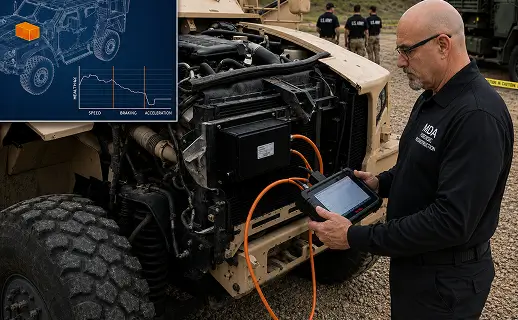
In involuntary manslaughter (Article 119), negligent homicide (Article 134), and drunken or reckless operation (Article 113) cases, the Event Data Recorder can be one of the most significant sources of evidence. Commonly referred to as the vehicle’s “black box,” the EDR records data in the seconds before and during a collision — data that can corroborate or contradict witness testimony, law enforcement estimates, and the assumptions that both the prosecution and the defense may bring to the case.
For JAG attorneys handling court-martial proceedings involving fatal or serious-injury collisions, understanding what EDR data can reveal, how it is preserved, and how it is used is essential.
Most modern passenger vehicles have an Event Data Recorder, usually as a function of the airbag control module (ACM). The federal rule, 49 CFR Part 563, does not require one; for light vehicles built on or after September 1, 2012 that have one, it standardizes what the EDR must record. The EDR monitors vehicle systems and, when an event crosses its trigger threshold or a restraint deploys, records a snapshot of data from the seconds before and during the event.
The specific data recorded varies by manufacturer, model, and model year. For vehicles subject to Part 563, it includes indicated vehicle speed, accelerator pedal (or throttle) position, and service brake status (on or off) in the seconds before the event; the driver’s seat belt buckle status; frontal airbag deployment timing; and the longitudinal change in velocity (delta-V) during the event — a widely used measure of crash severity. Many vehicles also record engine RPM, steering input, front passenger belt status, and ABS and stability control activity, and some newer vehicles record driver-assistance data such as forward collision and lane departure warnings.
Pre-crash data is recorded at fixed intervals — in most vehicles on the road today, two samples per second over at least the five seconds before the event — and the change in velocity during the crash at 100 samples per second. It is electronic data recorded by the vehicle’s own systems at the time of the event, and like any sensor data it has to be interpreted within its limits.
Consider a hypothetical Article 119 case arising from a fatal collision, where the central question is speed. A witness estimates the vehicle’s speed. The investigating officer estimates speed from tire mark measurements. The defense argues the driver was within the speed limit. The EDR data shows the vehicle traveling 78 miles per hour in a 35 zone, with the brake switch first recorded as on in the final half-second before the event.
That recorded data, checked against the physical evidence, narrows the dispute considerably. It does not decide the legal questions — whether the conduct amounted to culpable negligence is for the factfinder — but it gives both sides a documented factual basis to argue from. If the data instead shows the driver was at or near the speed limit and began braking earlier than alleged, it can undercut the government’s theory of the case.
EDR data also bears on the recorded seat belt buckle status, the timing of brake application, and delta-V — the recorded crash severity, compared with how severe the impact appears from the vehicle damage — each read within the limits described below.
An event data recorder is a contemporaneous record made by the vehicle itself, and that is why it carries weight. It is also a record with known limits, and those limits belong in the report next to the numbers.
The pre-crash data is a short buffer, not a continuous trace. In the vehicles most often encountered it covers at least the five seconds before time zero, at two samples per second; older modules that predate the rule vary. A recent federal rule change lengthens that buffer considerably for vehicles built in future model years, but it does not reach the vehicles in most cases now. And time zero is not the moment of first contact — it is the point at which the module’s algorithm woke or first detected a small change in velocity. In an oblique, offset, or underride impact those two moments can be meaningfully apart.
Recorded speed is normally derived from wheel or powertrain sensors rather than measured against the ground, so tire size, wheel lockup, drive-wheel spin, and ABS intervention can all move it away from true ground speed. The other pre-crash elements are coarser than they look: brake status is a switch state, not pedal force, and belt status is a buckle switch, not proof of proper use. The recorded change in velocity is captured over a window that closes when the module judges the event finished, so in a long or multiple-impact sequence the recorded value may not represent the whole collision — and in many vehicles only the longitudinal component is recorded at all. The federal specification itself allows ten percent on that figure.
In vehicles subject to the rule, a record written when a frontal airbag deploys — or a side or curtain airbag, in vehicles that record lateral delta-V — is locked against overwriting. Other records, including those from events where nothing deployed, may not be: in many modules they can be overwritten by a later event or aged out by ignition cycles, which is why the data should be retrieved as early as possible. And no single retrieval tool covers every make, model, and year.
The limit with the most consequence is the one that is easiest to miss. The module records an event only when the change in velocity crosses its trigger threshold or a restraint deploys. A contact below that threshold produces no record at all — so the absence of an event data recorder record is not evidence that no impact occurred. A missing record can also reflect an unsupported module or an overwritten event.
None of this makes the data less useful. It is what makes it usable: it defines the conditions under which the record can be relied on, and what has to be established some other way.
EDR data preservation in military cases presents unique chain of custody challenges. When a collision occurs on or near a military installation, the involved vehicles may be impounded by military police or security forces, secured by CID, NCIS, OSI, or CGIS, held at a host nation impound facility (in OCONUS cases), or released to the service member, their insurance company, or a salvage yard.
The critical issue is that EDR data can be lost. If the vehicle is repaired, the ACM may be replaced and the original module discarded. If the vehicle is salvaged or destroyed, the module goes with it. And in OCONUS cases, host nation authorities may release the vehicle before anyone on the U.S. side recognizes the forensic significance of the data it contains.
From the forensic side, the priorities are to identify the vehicle and where it is held, secure it against unauthorized access or modification, and retrieve the EDR data as early as possible, once the legal basis for access is in place — owner consent, a search authorization, or a court order, as the Driver Privacy Act of 2015 contemplates. The download itself can be quick where the Bosch CDR tool supports the vehicle; some vehicles require a manufacturer-specific tool. Either way, it depends on the module still existing and being accessible.
EDR data does not favor the prosecution or the defense. It records what the vehicle’s systems detected, which makes it valuable to both sides.
For trial counsel, EDR data can show speed, the absence or timing of braking, a driver belt recorded as unbuckled, and crash severity — facts that bear on whether the conduct was negligent, culpably negligent, or reckless. For defense counsel, the same data can show that the driver was at or near the posted limit, did apply the brakes, had a belt recorded as buckled, or that the crash severity is at odds with the government’s account. Where a mechanical problem is alleged, the recorded accelerator and brake data can be one line of evidence, although a malfunction claim has to be tested against a mechanical inspection.
A qualified forensic expert does not interpret EDR data to support a predetermined conclusion. The expert downloads the data, analyzes it in the context of the physical evidence, and reports what it shows.
A leading risk with EDR evidence in military cases is delay. Once the vehicle leaves secure custody — whether it is released to the service member, sent to a salvage auction, or repaired at a body shop — the window to retrieve the data may close for good. In OCONUS cases, where vehicles may be processed through host nation systems with different retention timelines, the risk is greater still.
In any case involving a vehicle collision, two questions are worth asking early: where is the vehicle, and has its EDR data been preserved? If the answer is uncertain, the sooner the vehicle is located and the data retrieved, the more options remain.
Air Force veteran. Qualified and accepted as an expert witness in courts-martial. Retainer waived for government and military counsel. Before sharing privileged case material, discuss confidentiality and expert-consultant appointment with counsel.
Gerald C. McDevitt
Low-speed impacts produce less vehicle damage but can still generate significant occupant forces — forensic reconstruction can distinguish…
 Gerald C. McDevitt
Proving that impairment caused a fatal collision — not just that the driver was impaired — requires a…
 Gerald C. McDevitt
A vehicle cannot leave a scene without leaving evidence — paint transfer, glass, tire impressions, and debris patterns…
 Gerald C. McDevitt
Tractor-trailer and fleet vehicle collisions involve federal regulatory requirements, electronic logging devices, and complex vehicle dynamics that demand…